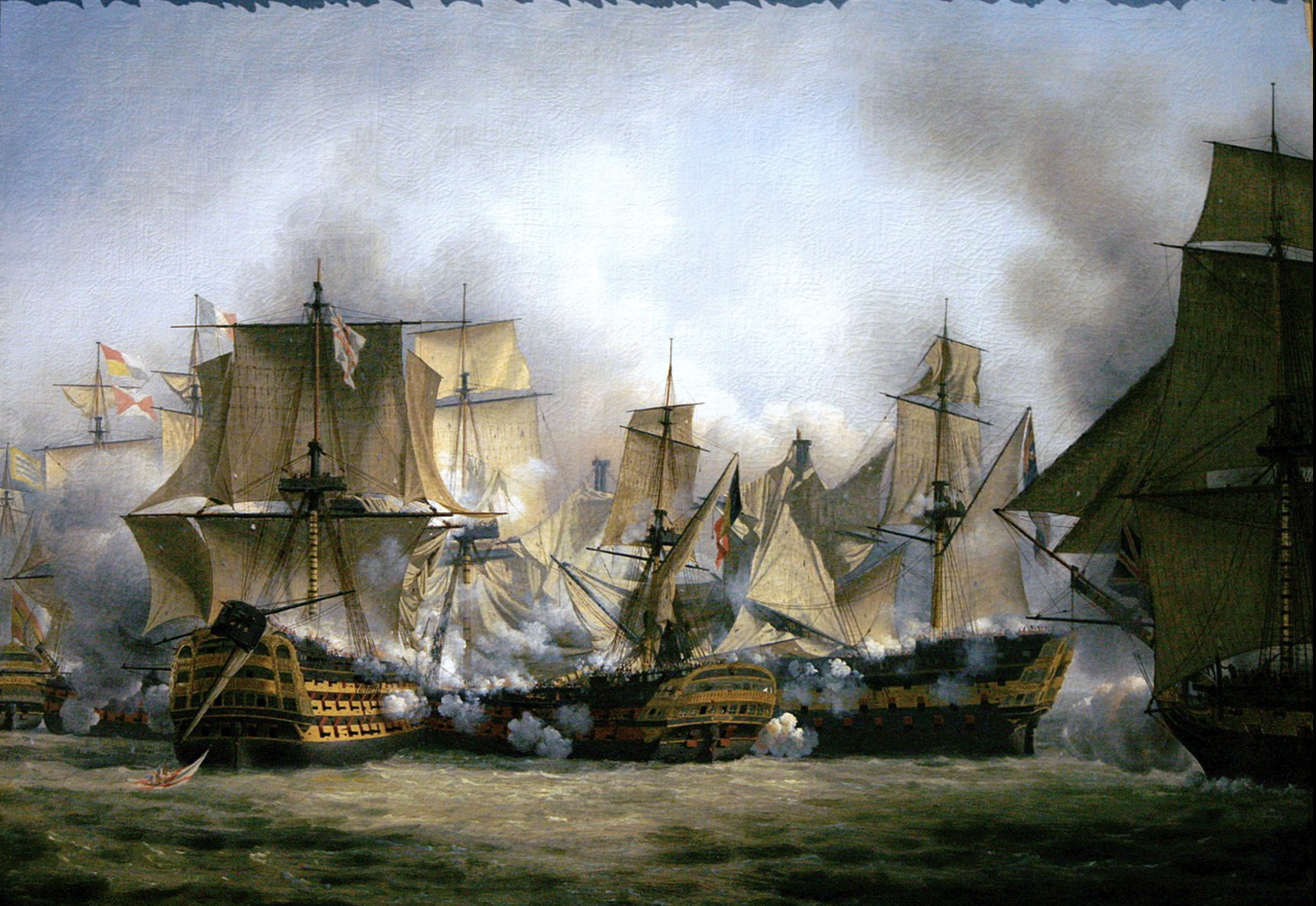
On October 21, 1805, off the coast of Cape Trafalgar, a naval battle took place that changed the course of European history. Imagine: 60 colossal wooden ships armed with cannons about to clash in an epic battle. The warships at Trafalgar represented the best of each nation: on one side, Nelson’s legendary Royal Navy Trafalgar; on the other, the allied French and Spanish armada.
The warships of Trafalgar numbered 60 vessels equipped with thousands of cannons. These famous Trafalgar ships carried sailors ready to fight to the end. Today, you can recreate these ships with the models in the Artesanía Latina catalog.
The British Navy: HMS Victory and the other ships
The British fleet at Trafalgar consisted of 27 ships under the command of Admiral Nelson. HMS Victory Trafalgar was the undisputed king.
Launched in 1765, this giant measured 69 meters and carried 104 cannons on three decks. With its 820 crew members, the Victory was a floating castle built with 6,000 oak trees. Its cannons fired 32-, 24-, and 12-pound projectiles. This ship still exists today: you can visit it in Portsmouth, where it is the oldest warship in the world still in service.
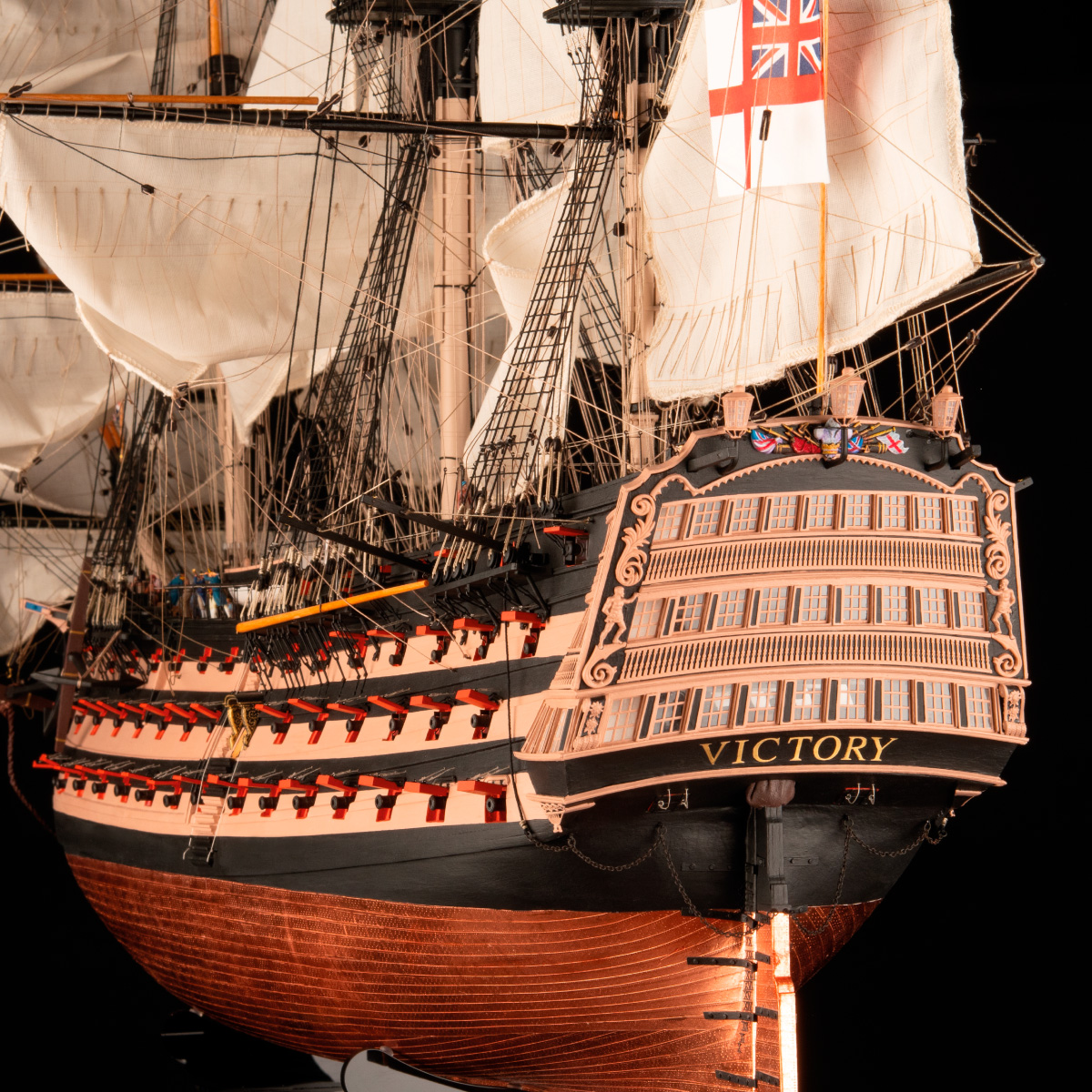
HMS Victory technical specifications:
- Length: 69.34 meters
- Width: 15.80 meters
- Displacement: 3,500 tons
- Armament: 104 guns
- Crew: 820 men
- Speed: 8-9 knots
Alongside the Victory sailed HMS Royal Sovereign, equipped with 100 guns, which was the first to break through the enemy line, and HMS Temeraire (98 guns), which then rescued the Victory. Ships with 74 guns, such as the Belleisle, the Colossus, and the Ajax, formed the backbone: a perfect balance between power and maneuverability. This design became the standard for ships of the line at Trafalgar.
The Spanish Navy: the Santísima Trinidad and Spanish ships
The Spanish ships at Trafalgar represented centuries of tradition. The Spanish navy of 1805 had 15 ships, including the most impressive.
The Santísima Trinidad was unique: the largest ship in the world with four decks and 130 to 140 guns. Built in Havana in 1769, it measured 61 meters and displaced nearly 5,000 tons. Its crew of 1,050 men wielded a devastating arsenal. During the battle, it fought heroically against seven British ships that surrounded it until it was destroyed.
Santísima Trinidad technical specifications:
- Length: 61.30 meters
- Width: 16.20 meters
- Displacement: 4,900 tons
- Armament: 130-140 guns
- Crew: 1,048 men
- Speed: 7 knots
Other notable ships included the Santa Ana, armed with 112 guns, which fought an epic duel against the Royal Sovereign, and the Príncipe de Asturias, armed with 118 guns, Gravina’s flagship. The Argonauta, Bahama, Monarca, and San Juan Nepomuceno (all armed with 74 guns) completed the formation.
The Spanish built their ships with exceptional American woods, particularly Cuban mahogany, which offered superior strength. The problem was a lack of experience due to British blockades.
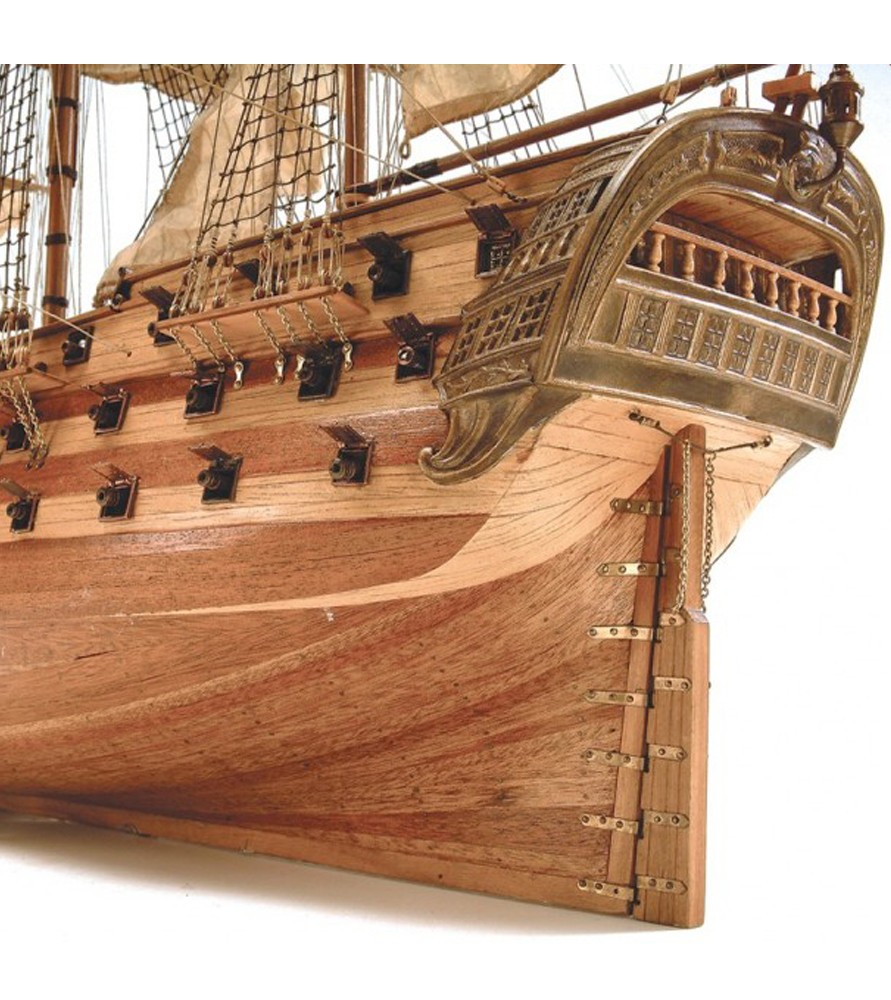
French Navy: Bucentaure and Villeneuve’s ships
The French ships at Trafalgar numbered 18 vessels under Villeneuve’s command. They were the very embodiment of French naval elegance.
The Bucentaure Trafalgar was Villeneuve’s flagship, an 80-gun ship launched in 1803. At 58 meters long and with a crew of 750, it represented French design: sleek lines, superior speed, and excellent handling. The French built the most refined ships. During the battle, the Bucentaure was severely damaged, losing all its masts before being captured.
Bucentaur technical specifications:
- Length: 58.00 meters
- Width: 14.80 meters
- Displacement: 2,400 tons
- Armament: 80 cannons
- Crew: 750 men
- Speed: 10 knots
The Redoutable, with its 74 guns, is legendary: it was from its mizzenmast that a gunner fired the shot that killed Nelson. The Fougueux, the Indomptable, and the Neptune (all equipped with 74 guns) demonstrated French quality, even if their crews lacked experience. The frigates at Trafalgar played a limited role, focusing on reconnaissance and rescue.
What are the characteristics of ocean liners?
Trafalgar ships of the line were a formidable weapon. They fought in line formation, maximizing their lateral firepower.
They all shared the basic characteristics of Trafalgar ships: three masts with square sails, a wooden hull reinforced with oak, and a copper-covered bottom to protect against marine organisms.
They were classified according to their guns. First class: more than 100 guns on three decks. Second class: 84 to 98 guns on three decks. Third class (the most common): 64 to 80 guns on two decks. Fourth class: 50 to 60 guns, already obsolete by 1805.
The armament consisted of smoothbore cannons firing iron balls. Heavy calibers from 32 to 36 pounds at the bottom, light calibers from 12 to 8 pounds at the top. Plus carronades (short cannons for close combat) and swivel guns against boarding.
The crew: the gunners operated the cannons, the sailors maneuvered the sails, the marines fought, and the carpenters ensured that everything ran smoothly. A 74-cannon ship required 500 to 650 men.
Technical comparison of the fleets participating in the Battle of Trafalgar
At first glance, comparing the size and power of the fleets gives a clear impression. At Trafalgar, the combined fleet seemed to have the upper hand due to its numerical superiority: 33 ships against 27 for the British. But history is rarely summed up in numbers, and in this case, the numbers masked a very different reality.
The British advantage lay in experience. Their crews had been sailing for years. The British fired every three minutes, while the Franco-Spanish fired every five or six minutes. In naval combat, this difference is fatal.
In terms of raw power, the combined fleet had 2,632 guns compared to 2,148 for the British. But the British had better accuracy, better gunpowder, and special projectiles: chain shot to destroy rigging and grape shot to sweep the decks.
In terms of design, the French had the advantage with slimmer, faster hulls. The Spanish built extremely sturdy ships with tropical woods. The British compensated with superior standardization and tactical coordination.
The list of ships at Trafalgar shows that the British concentrated 18 ships with 74 guns: the best balance. The combined fleet had everything from the monstrous Santísima Trinidad to obsolete 64-gun ships. This mix made coordination difficult.
Recreate the Battle of Trafalgar with Artesanía Latina models
For naval model enthusiasts, Artesanía Latina offers models faithful to the history of the main protagonists of Trafalgar. These replicas allow you to relive this epic battle.
The HMS Victory is available in several versions: open on one side so you can appreciate every detail of its anatomy, closed, or perhaps you would prefer to see the interior with this section of the Victory. The 1:84 version is 105 cm long and includes over 1,000 pieces of fine wood, metal cannons, and a complete rigging with sails. Every detail is faithfully reproduced: from the 104 gunports to the golden decorations on the stern where Nelson’s flag flew.
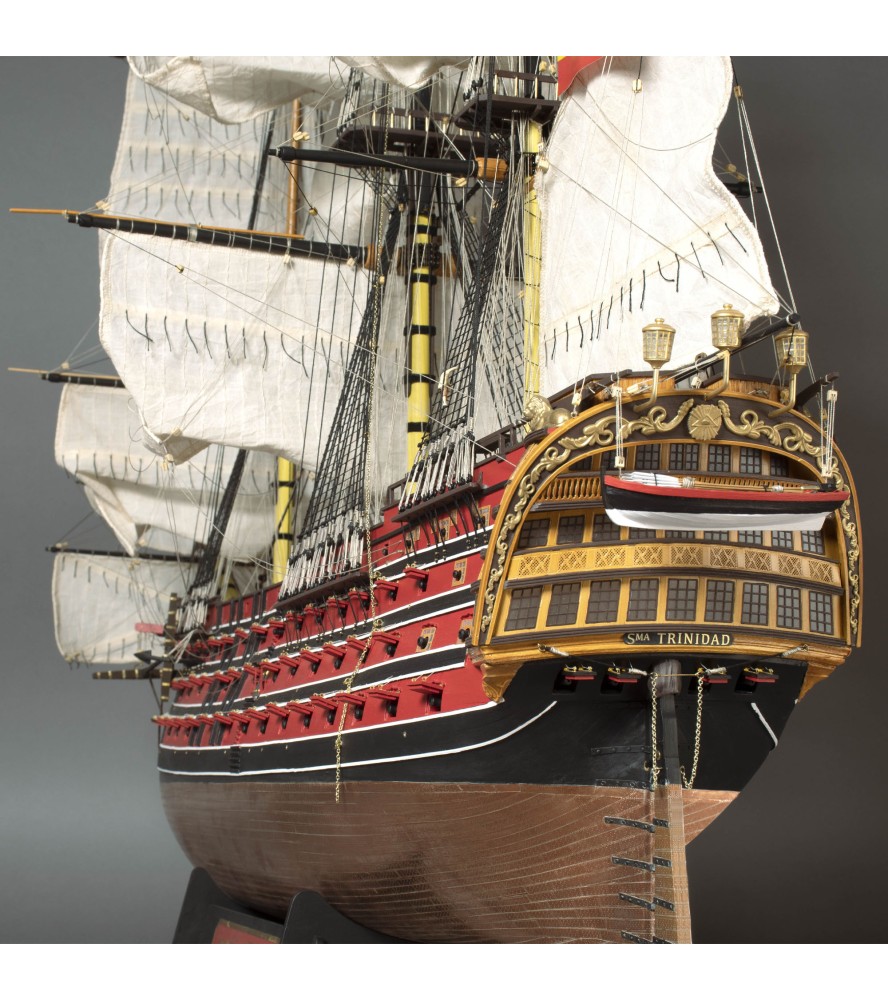
The Santísima Trinidad is available in 1:84 scale, reaching an impressive length of 1191 mm and a height of 905 mm. This model captures the unique majesty of this four-deck ship equipped with 140 cannons. It includes detailed plans, high-quality wood, and photo-etched brass fittings for maximum realism.
The San Juan Nepomuceno, a Spanish 74-gun ship that bravely participated in the Battle of Trafalgar, is also available. At a scale of 1:90, this model measures 960 mm and faithfully represents Spanish shipbuilding of the time with its characteristic American woods.
Each kit includes step-by-step instructions in Spanish, historical plans, and all the necessary materials. These projects require between 200 and 400 hours of work, which is perfect for truly understanding how these giants of the seas were built. Assembling these models is the best way to appreciate the complexity and ingenuity of the ships of the line at Trafalgar.
Shipwrecks and survivors of Trafalgar
The outcome of Trafalgar was devastating for the Franco-Spanish fleet. No British ships were lost that day, while the Spanish-French fleet lost twenty-two of its ships. And when the battle ended, the disaster was not over yet: a violent storm finished what the artillery had started.
The Santísima Trinidad, after resisting for hours with legendary tenacity, was finally captured. However, its agony did not end on the battlefield: the next day, it sank, taking with it hundreds of prisoners and those who were attempting to escort it. The Bucentaure suffered a similar fate, captured and deliberately sunk, while the Redoutable was lost after its fierce duel with the Victory.
Some ends were even more brutal. The Achille exploded when fire reached the ammunition hold, killing four hundred of its four hundred and eighty crew members. The Fougueux was wrecked on the coast, and the San Agustín, the Intrepide, and the Argonauta succumbed to the fury of the storm. The human toll was appalling: more than 4,400 French and Spanish dead, compared to 450 British. Today, the remains of this tragedy lie scattered off Cape Trafalgar, silent witnesses to the battle.
The Fougueux was located near Cadiz; the Santísima Trinidad lies at a greater depth, beyond the reach of time and sight. Only one ship has survived the passage of centuries: HMS Victory. Restored to its 1805 condition and preserved in Portsmouth, it allows visitors to walk the same decks from which Nelson led his last battle. A place where history, even today, seems not to have completely disappeared.
FAQ – Frequently Asked Questions
How many ships took part in Trafalgar? 60 ships of the line: 27 British against 33 Franco-Spanish (18 French and 15 Spanish), plus frigates.
What was the largest ship? The Spanish Santísima Trinidad, the only four-decked ship equipped with 130 to 140 guns.
What were the differences between the ships? The French built faster hulls, the Spanish used strong tropical woods, and the British favored rate of fire.
How many guns did each ship have? Between 64 and 140 guns. The Victory had 104, the Santísima Trinidad 140.
Which ships sank? Twenty-two Franco-Spanish ships: Santísima Trinidad, Redoutable, Fougueux, Achille, Bucentaure, Argonauta. No British ships.
Where are the shipwrecks located? On the seabed off Cape Trafalgar and the coast of Cadiz. Some have been located by archaeologists.
Why was HMS Victory famous? Nelson’s flagship and the only survivor of the Battle of Trafalgar, it is preserved as a museum in Portsmouth.
How many crew members did each ship have? Those with 74 guns: 500 to 650 men. Those with 100 guns: 850. The Santísima Trinidad: more than 1,000.